Kitchen-access buying guide
Best Foldable Step Stools for Reaching Meal-Prep Storage
A step stool is useful only when it provides enough reach for a repeated storage task and can be opened, used, and put away according to its instructions. Measure the cabinet and the intended storage spot first; do not choose by advertised height or capacity alone.
As an Amazon Associate, GoodWeighFinds earns from qualifying purchases.
Who this guide is for
This guide is for adults who can use a consumer step stool and repeatedly need an ordinary prep tool, mixing bowl, or empty container from higher kitchen storage. If the item is heavy, the reach requires twisting, the floor cannot stay clear, or climbing does not feel steady, reorganizing the cabinet is the better first move.
For lower shelves that waste vertical space, first check whether a shelf riser can move lightweight items into reach. For broader low-hype kitchen choices, use the routine-support tools pillar.
Useful formats, not universal winners
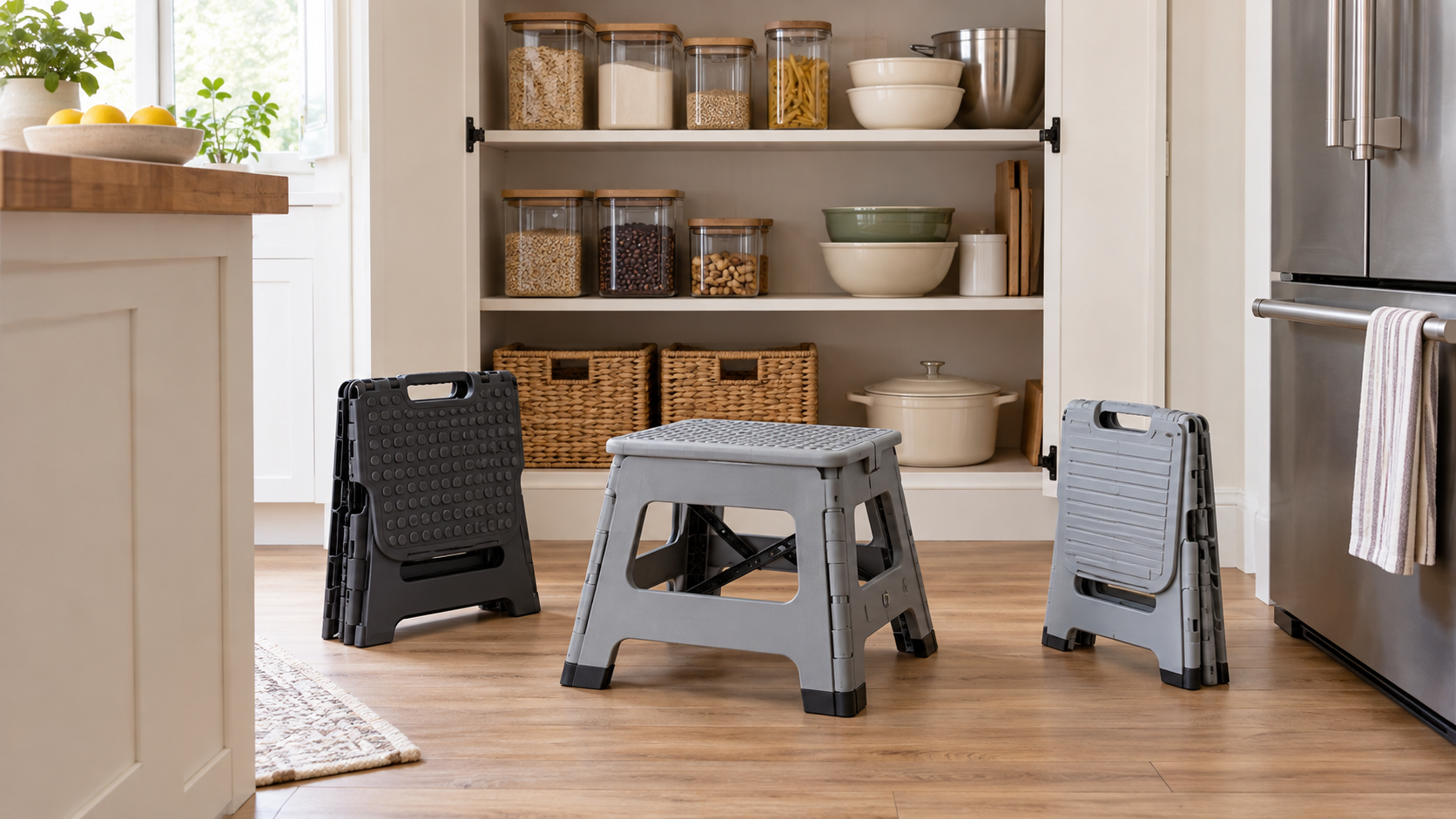
- Single-step folding stool: Compact and simple when one modest rise reaches the intended shelf; verify the complete open footprint and the maker's intended use.
- Two-step folding stool: Adds height but also open depth, climbing movement, and storage bulk. A handhold or rail is useful only as described by its maker.
- Folding platform stool: A broader standing surface may suit repeated stationary access, but platform size does not replace correct setup or placement.
- Nonfolding alternative: If the stool can remain safely in a dedicated spot, a nonfolding design may remove hinge and setup steps. It still requires the same fit and instruction checks.
Measure the task before shopping
- Identify the exact shelf and the light items you need there most often.
- Measure the floor area with cabinet and appliance doors in their normal positions.
- Estimate only the small additional rise needed; do not buy extra height as a general-purpose shortcut.
- Measure the proposed folded storage slot, including handle and hinge projections.
- Move heavy, awkward, fragile, hot, or spill-prone items to a lower shelf instead of planning to carry them while climbing.
Selection criteria that matter
- Open dimensions: Check width, depth, and platform height in the maker's specifications. Confirm the footprint stays fully on one level surface.
- Folded dimensions: Measure thickness as well as height and width. A slim stool is not useful if it blocks a door or becomes a trip hazard when stored.
- Opening and locking: Read how the maker says the stool reaches its ready-to-use position and how that position is confirmed. Do not infer a lock from photos.
- Platform and steps: Look for disclosed dimensions and tread details. Marketing words such as "wide" or "non-slip" need actual specifications and use instructions.
- Feet and floor guidance: Check foot material, contact area, replacement guidance, and approved floor conditions. No foot design guarantees slip prevention.
- Stated capacity: Use only a clearly identified manufacturer limit for the exact model, including anything carried. A capacity number does not prove stability or suitability.
- Handling: Check the stool's own weight, carry grip, pinch points, and whether it can be unfolded without placing fingers near moving joints.
- Instructions and labels: Prefer listings that provide model-specific warnings and a manual, not only seller-written feature claims.
- Inspection and parts: Check maker guidance for loose hinges, damaged feet, cracked components, corrosion, and when to stop using the stool.
- Return terms: A stool can meet its listed dimensions and still fit the room poorly. Check current seller and return details before ordering.
A kitchen placement test
Mark the listed open footprint on the floor with removable tape. Open nearby cabinet, pantry, refrigerator, and oven doors and keep the normal walkway clear. From the floor, identify whether the intended item can be grasped without leaning sideways or rotating with a load. If the setup forces the stool near a door swing, wet zone, mat edge, or busy passage, change the storage layout instead.
Claims to treat cautiously
"Heavy duty," "safe," "stable," "anti-slip," and "easy fold" are broad marketing claims unless the exact model's construction, dimensions, instructions, and limits explain them. Certification language also needs a named standard, product scope, and verifiable source. Customer anecdotes are not proof that a stool fits your floor, reach, or use.
A stool can make an upper shelf reachable. It cannot prevent falls, make carrying awkward loads safe, solve balance limitations, or produce any weight-loss result.
Who should skip this purchase
Skip or delay the purchase if cabinet reorganization can bring frequent items between waist and shoulder height, if the required item is heavy or needs two hands, or if the only setup area is uneven, wet, obstructed, or in a door path. Anyone whose balance, vision, strength, pain, dizziness, medication effects, or mobility could make climbing uncertain should use a safer storage arrangement and seek appropriate individualized guidance rather than relying on a general consumer buying guide.
Bottom line
The best foldable step stool is the lowest suitable model that fits the measured task, opens fully on a clear level floor, has understandable model-specific instructions, and stores without creating another hazard. Verify every dimension and claim on the current listing and manual—and reorganize the shelf when reaching still requires leaning, twisting, or carrying an awkward load.